
Little Duchrae - Where Stories Began
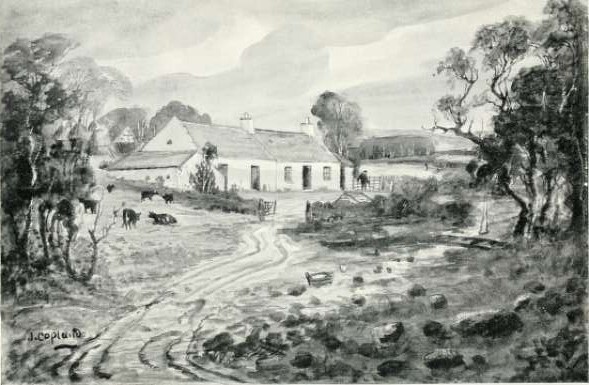
At a 108-acre farm in the Galloway hills, young Sam Crocket received an education no school could provide: stories of Scotland's Covenanters and the authentic dialect that would distinguish his writing.
The Household
Little Duchrae was a single-storey stone farmhouse on the Hensol Estate, worked by Sam's grandfather William Crocket (1794-1875) and Uncle John. The house was full of family. Sam's uncles William and Robert slept in 'the laft', as he later recalled—the loft space above. His grandmother Mary Crocket (née Dickson, 1802-1884) managed the household.
The young Sam played in the area with his cousin Will (son of Uncle Samuel), with collie dogs, and even with a sheep named Donald. The farm and its surroundings became the landscape of his childhood imagination.
Stories and Language
In a letter to his biographer Malcolm Harper in October 1906, Crockett described his grandparents' influence. Of his grandfather William, he wrote: 'It was from him I learn that sympathy for the "Men of the Moss Hags" which has never been out of my blood—though God knows, many of my actions have been little in keeping with the creed of Richard Cameron and Alexander Peden.'
William's tales of Scotland's 17th-century Covenanters—Presbyterians who had resisted religious persecution—planted the seeds for Crockett's later fiction. These stories belonged to Galloway's landscape, to the very hills Sam could see from Little Duchrae.
Crockett continued in his letter to Harper: 'I have always a great reverence for my grandfather, chiefly I think, because he was the sole person I had to speak to all day until the evening—when my grandmother took me in hand...I learned my Scots—Gallawa of course I think, the real old brand—from her.'
Mary's Galloway dialect gave Crockett the authentic voice that would distinguish his fiction. This was living speech, not literary imitation—the language as generations had spoken it.
School Days
From about age four, Sam walked four miles each day to Laurieston School, where Duncan Robertson served as headmaster. The journey itself taught him the landscape's moods and seasons. Robertson would later appear, unflattering fictionalised, as Duncan Duncanson in Crockett's novel Kit Kennedy.
The landscape between Little Duchrae and Laurieston became so deeply embedded in Sam's imagination that it would form the foundation for much of his Galloway-based fiction.
A Place Transformed Into Fiction
Little Duchrae itself reappeared throughout Crockett's novels under various names—'Black Dornall', 'Craig Ronald'—each time carrying authentic detail only childhood memory could provide.
The farm gave young Sam Crocket everything he needed: historical consciousness from his grandfather's stories, authentic dialect from his grandmother's speech, and intimate knowledge of Galloway's landscape. When the family left for Castle Douglas in 1867, Sam was seven years old. But Little Duchrae never left him.
Illustration of Little Duchrae by John Copland from Crockett and Grey Galloway by Malcolm McLachlan Harper (1907)