
Journalism and beyond
By the early 1890s, Sam balanced ministry with growing literary ambition. He wrote stories, reviewed books, and developed a distinctive voice.
Writing in the Margins of Ministry
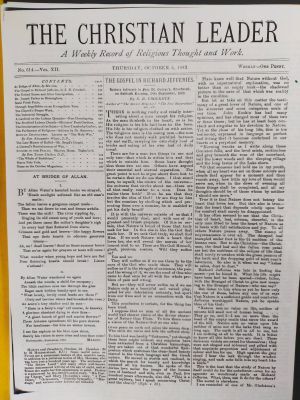
Sam produced short stories and journalism, often drawing on familiar landscapes and communities. When William Howie Wylie died in 1891, Crockett stepped into the editorial role at the Christian Leader. He edited magazines and was prolific in his output.
During this period, Crockett contributed over one hundred articles to the Christian Leader. His series included 'Ministers of Our Countryside', 'The New Naturalists', 'Congregational Sketches', 'The Laureates of Labour', and 'Literary Vignettes'. He also serialized 'A Galloway Herd', experimenting with longer narrative forms.
The magazine provided space to test material, develop his voice, and learn which stories resonated with readers. The dual role of minister and editor gave him both subjects and audience for his emerging fiction.
Building Connections
Through his editorial work, Crockett also strengthened connections with key figures in the literary world. William Robertson Nicoll, the influential editor of The British Weekly and The Bookman, became both friend and professional ally. It was Nicoll who introduced Crockett to T. Fisher Unwin, a publisher building a reputation for discovering new talent.
These connections represented more than social networking. They were the practical infrastructure of a professional writing career—the editors, publishers, and agents who could transform manuscript pages into published books and regular income.
Sam maintained connections with artists and writers from his Castle Douglas and Edinburgh days, building a network that would support his literary career.
Manuscripts & Opening Doors
On the last day of 1892, Crockett wrote to T. Fisher Unwin. He promised to send a manuscript within 'a week or 10 days', offering various potential titles for the collection. The stories, many of which had appeared in the Christian Leader, would become The Stickit Minister.
Crockett had spent years developing his craft through journalism, building his audience through magazine publication, and establishing connections through editorial work. By 1892, he stood on the edge of recognition. Now he was ready to take the offered opportunity of reaching a broader market.
On the Edge of Fame
By December 1892, Sam Crocket had lived several lives: farm boy, pupil-teacher, student, traveller, critic, minister, husband, and father. Each phase shaped the writer he was about to become.
The next chapter—the rise of S.R. Crockett, bestselling author—would bring fame, controversy, and a readership across the world. But the foundations were laid long before.
This exhibition has traced the making of a writer. The story continues in the books he left behind. You can discover much more by visiting The Online Museum's Reading Room and The Library . Future exhibitions will cover many more aspects of Crockett's life and works through the digitised 'fact and fiction' archival material which forms the substance of our museum.