
A Peculiarly Deadly Blue
Provincial Publishing and What It Reveals
Crockett's description of Janet's self-published book occupies fewer than a hundred words, but every detail counts. The paper, the binding colour, the proof correction method: each element reflects insider knowledge of provincial printing that could only come from direct experience.
The book, Crockett writes, was 'a small, rather thickish octavo, on sufficiently wretched grey paper which had suffered from want of thorough washing in the original paper-mill. It was bound in a peculiarly deadly blue.' The 'rectified Reckitt tint' he names is a specific brand of laundry bluing used in cheap bookbinding. This is not the vocabulary of someone imagining provincial publishing from the outside. It places Crockett inside the material realities of how books were actually produced — and physically marked by their origins — in rural Scotland.
The object announces its provenance before anyone reads a word. The colour of the binding signals provincial origins as surely as an accent marks regional speech. Literary legitimacy, Crockett shows, depends not on the quality of the writing inside but on the signals the physical book sends about where it came from.
Janet's method of correcting proofs completes the picture. She corrects 'by again writing the whole poem out in a neat print hand on the edge of the proof, and underscoring the words which were to be altered.' She lacks access to conventional editorial protocols, so she improvises with what she has. This is not inefficiency. It is what you do when you are excluded from professional systems but determined to be heard anyway. Crockett's narrator notes that this, 'when you think of it, is a very good way' — a quiet acknowledgment of both Janet's ingenuity and the pathos of her situation.
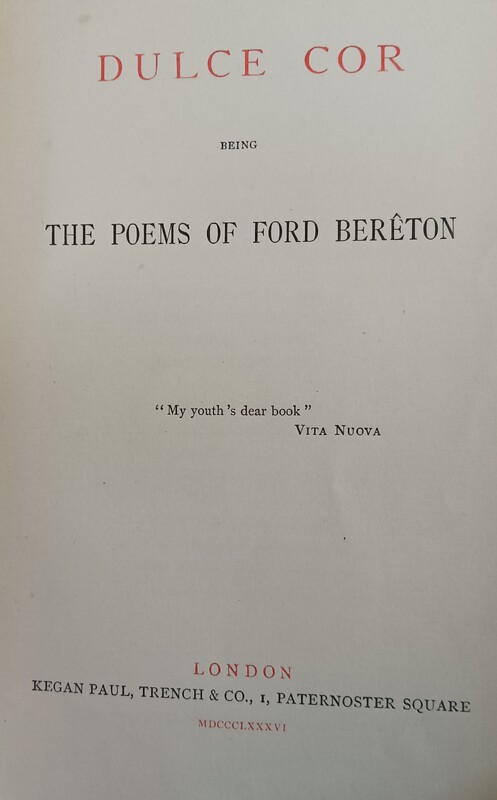
The biographical parallel is precise. Crockett's own poetry collection Dulce Cor (1886) was published pseudonymously, essentially at his own expense, and received no critical acclaim. In the period immediately before his literary breakthrough, he was writing to his publisher T. Fisher Unwin in January 1893 with his own suggestions for the look of The Stickit Minister — a writer acutely conscious of how his books were physically presented, and of how little control he had over that presentation. Janet's story draws on this experience directly.
Publishing hierarchies, Crockett shows, privilege access over merit. The 'peculiarly deadly blue' binding is a metaphor for everything that determines a writer's reception before a single line is read — geography, economics, institutional backing. Crockett knew this at first hand. He placed that knowledge at the centre of the story.