
How to Hide a King
The Craft
The easiest thing Crockett could have done with the Ballangiech tradition was to reproduce it — give the king a plausible alias, put some ruffians on the road, and end with a revelation scene. What he actually did is more interesting.
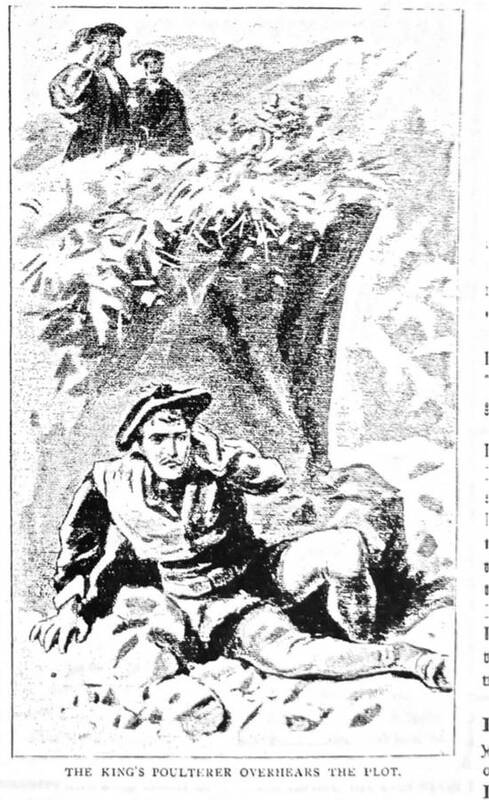
Scott's disguised king travels as 'James Fitz-James,' a knight whose alias suggests noble lineage — the king hidden upward, into romance. Even Scott's prose version is vague: 'a poor man with a small appointment about the palace.' Crockett's alias goes in the opposite direction entirely. 'James Jamieson, the King's poulterer' — the man who supplies the royal household with eggs, butter, and birds for the table. The monarch of the realm disguised as the man who delivers his own breakfast. The joke has a political edge that neither of Scott's versions approaches, and it draws simultaneously on the civic Ballangiech tradition and the spirit of the older Gaberlunzie Man ballad — the king hiding downward, into comedy. It also suggests: this is what happens when Scotland’s King comes to Galloway.
More consequentially, Crockett moves the story's real danger inside the court. Scott's versions have no true villain — the ruffians at Cramond Bridge are generic, Roderick Dhu is elemental. Sir Allan St. Clair, the King's own favourite, is the architect of the conspiracy in Crockett's story: silk-clad, charming, and planning robbery, abduction, and murder from inside the household sheltering his disguised master. The St. Clair name carries historical resonance — the Rosslyn family had a long relationship with the Scottish crown — and Crockett's characteristic use of a changed forename signals deliberate fictionalisation of a real connection.
And then there is Elspeth Kennedy. She exists nowhere in Scott. Sharp-tongued, gossip-gathering, instantly dazzled by a fine doublet, ending the story kneeling before the revealed king in her 'coronation robe of shawls' — she is entirely Crockett's invention, and the surest single sign of his own hand in the story.